What If Global Trade Didn’t Require Trust?
By Noam Rosenfeld, CEO of WaveBL
For centuries, global trade has been built on trust. Traders, customers, carriers, banks, and other participants have had to trust one another and, above all, trust the documents representing the goods, their ownership, and the rights associated with each transaction.
But as trade becomes increasingly digital, trust has become one of its biggest infrastructure challenges.
Today, critical trade documents still move across paper, emails, fragmented systems, portals, and organizations. Every handoff can require another verification, reconciliation, or manual check. Businesses spend time confirming that documents are authentic, that the information is accurate, that the right party holds the right document, and that they can safely act on it.
The result is more than operational inefficiency. It slows trade itself.
Processes take longer. Financing is delayed. Errors and discrepancies require manual intervention. Organizations build additional controls to manage risk. Valuable data remains trapped inside documents and disconnected workflows. Most importantly, businesses cannot always act on trade information with the speed and confidence that a truly digital world should enable.
For companies operating at global scale, solving this problem creates significant business value. When documents can be trusted and acted upon immediately, transactions can move faster, operational friction can be reduced, financing can become more efficient, and companies can serve more customers without adding the same level of complexity and manual work.
WaveBL was built to change this equation.
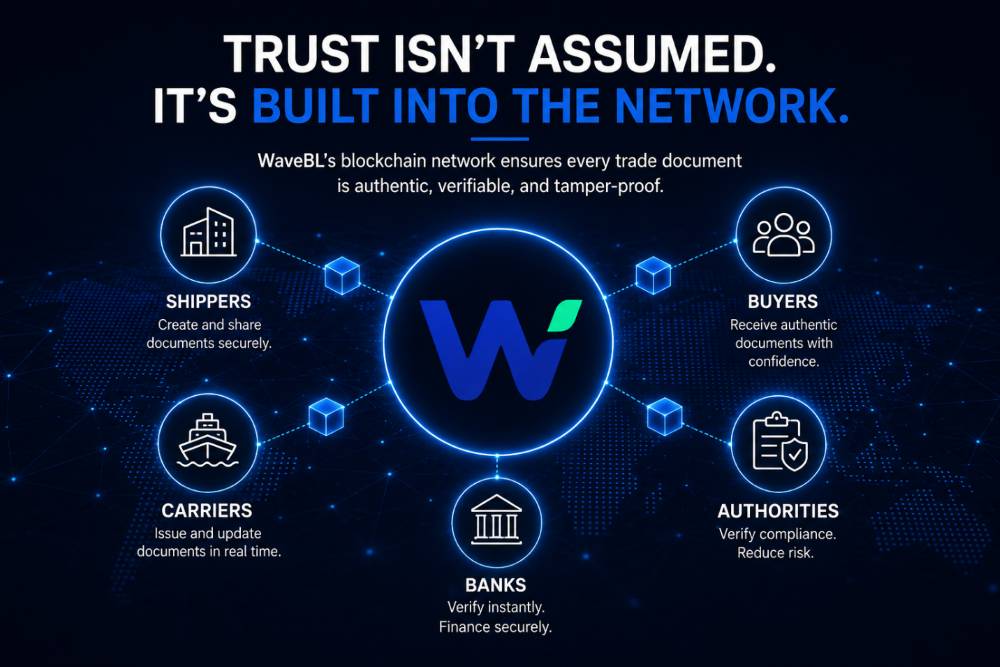
At its foundation is a blockchain-based network infrastructure that creates a shared trust layer for global trade.
Instead of requiring every participant in a transaction to establish bilateral trust with every other participant or rely on copies of documents exchanged between disconnected systems, WaveBL enables original trade documents to be securely created, transferred, and possessed while preserving their authenticity, uniqueness, traceability, and legal possession.
In other words:
Trading parties don’t need to trust each other. They can trust the infrastructure that connects them.
This changes what businesses can do with trade documents.
A carrier can issue an original document digitally. An exporter can securely transfer it. A bank or financing provider can confidently act on it. An importer can verify possession and authenticity. Other participants can interact with the same trusted information throughout the transaction.
The result is not simply greater security. It is the ability to move faster, reduce risk, automate processes, accelerate financing, and create better experiences for customers and partners.
But trust is only the foundation of the WaveBL story.
Once trusted infrastructure exists, it can enable much more than the secure transfer of original documents. It becomes the foundation for the entire trade document lifecycle, enabling documents and the trusted data within them to be generated, validated, corrected, transferred, financed, and used to trigger the next step in a trade process.
This is where WaveBL is evolving today.
We are building a connected trade document services layer that combines blockchain-native trust, operational trade services, and AI-powered document services, connecting carriers, exporters, importers, freight forwarders, banks, financing providers, authorities, and digital platforms across the global trade ecosystem.
The ambition, therefore, is much bigger than replacing paper with digital documents.
It is about creating an infrastructure where trusted documents and trusted data can move seamlessly across organizations and workflows, allowing every participant to act on them with confidence and enabling entirely new levels of automation, efficiency, and connectivity across global trade.
WaveBL is not simply digitizing trade documents. We are building the trusted infrastructure that connects the trade document lifecycle and enables global trade to move faster.