The next battle in digital trade will not be about who has the best technology. It will be about who has the network that can make that technology usable at scale.
When companies evaluate an electronic Bill of Lading solution, they naturally focus on the technology: security, legal compliance, integrations, usability, and reliability.
All of these are essential. But they are not enough.
An eBL is not a standalone digital document. Its real value exists only when it can move securely between the different parties involved in a trade transaction.
This is why, in digital trade, the size and reach of the network matter enormously.
An eBL Is a Network Product
Think about the difference between digitizing an internal document and digitizing a Bill of Lading.
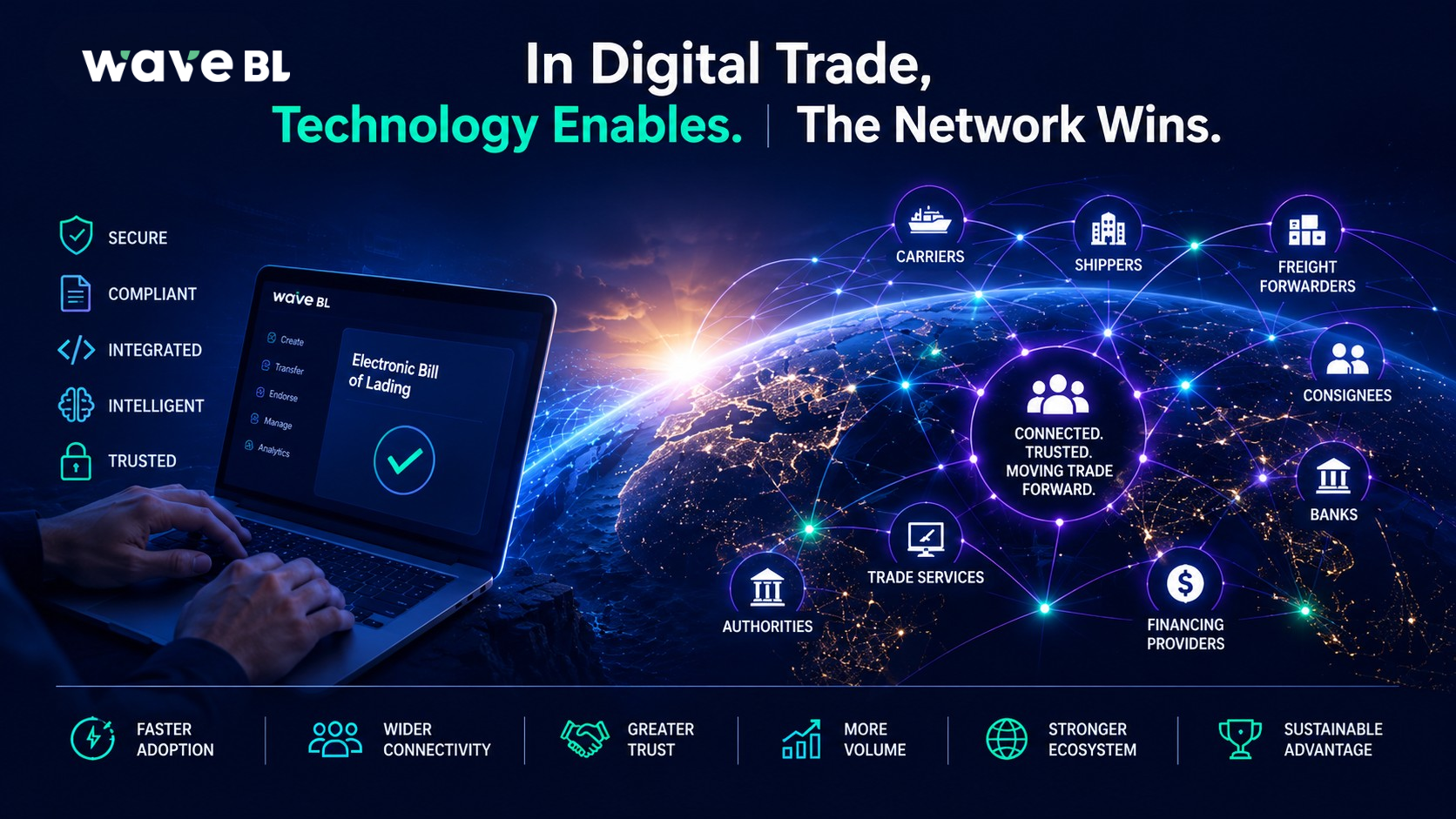
An internal document may involve one company and one system. A Bill of Lading can move between a carrier, shipper, consignee, freight forwarder, bank, financing provider, and other parties – potentially across several countries.
If one company is ready but the other participants are not connected, digitalization becomes a project.
If those participants are already part of the same network, digitalization can become a transaction.
That is the fundamental difference.
The Larger the Network, the Faster the Path to Value
Over the years, WaveBL has built a network connecting major participants across the global trade ecosystem.
This network creates an important advantage that goes beyond scale itself.
When a new company wants to start using electronic Bills of Lading, the question is not only:
“How quickly can we implement the technology?”
The more important question is:
“How many of the parties we trade with can we already transact with digitally?”
The larger the existing network, the greater the probability that a customer’s counterparties are already connected, familiar with the process, or capable of joining it quickly.
That can dramatically shorten the distance between the decision to adopt eBL and the first meaningful volume of digital transactions.
From Integration Project to Immediate Connectivity
Without an established network, every new digital trade flow can require multiple parties to be identified, onboarded, integrated, tested, and approved.
The same work is repeated transaction by transaction and partner by partner.
A mature network changes this equation.
When carriers, shippers, freight forwarders, financial institutions, and other trade participants already operate on the infrastructure, much of the foundation required for the next transaction already exists.
The value therefore compounds.
Every new participant does not simply add another user. It potentially creates new digital trade routes between existing participants.
That is the power of a network.
Network Size Creates More Than Convenience
A large network does more than make onboarding easier.
It creates optionality.
A company does not trade with the same carrier, bank, customer, or supplier forever. Trade flows change. New markets open. Financing relationships evolve. Supply chains move.
A broad network allows companies to operate digitally across more of those changing relationships without rebuilding the infrastructure each time.
Instead of implementing a solution for one specific transaction or bilateral relationship, companies gain access to infrastructure designed to support many relationships across the trade ecosystem.
This distinction becomes increasingly important as organizations move from their first eBL transactions toward large-scale adoption.
The Network Effect Accelerates Adoption
There is also a powerful network effect.
The value of a digital trade network increases as more participants join it.
A new shipper makes the network more valuable to carriers and banks.
A new carrier makes it more valuable to shippers and consignees.
A new financial institution expands the possibilities for digital trade finance.
And each additional participant makes it easier for the next company to find its existing business partners already inside the network.
This creates a positive cycle:
More participants → more possible transactions → easier adoption → more volume → more participants.
Why This Matters for WaveBL
WaveBL’s advantage is therefore not only the technology we have built.
It is the combination of technology and network (our network includes 7 of the world’s 12 largest shipping carriers, 30 of the world’s 50 largest freight forwards and leading banks),
The secure infrastructure enables an electronic original to be created, transferred, controlled, and managed digitally.
The network makes it possible for that document to move between real companies involved in real trade.
And the larger that network becomes, the faster we can help a new participant move from “we want to use eBL” to “we are using eBL in our daily business.”
That difference is critical.
Because ultimately, customers do not want an eBL platform.
They want their trade to become digital.
And the fastest way to make that happen is not to start building a network around every new customer.
It is to connect them to a network that already exists.
The Real Competitive Advantage
Technology can be developed. Features can be copied. Integrations can be built.
A trusted network of global trade participants is much harder to recreate.
It takes years of transactions, relationships, integrations, operational experience, trust, and adoption to build.
That is why the network should not be viewed simply as part of the WaveBL solution.
The network is one of the solution’s greatest assets.
And in a world where the industry increasingly understands why it should move from paper to digital, the next competitive question may no longer be:
“Who has the technology?”
It may be:
“Who can connect me to the digital trade ecosystem fastest?”
That is where network scale becomes a decisive advantage.