For years, the global trade industry has been discussing the transition from paper Bills of Lading to electronic Bills of Lading (eBLs).
The technology is available. International standards are advancing. Legal frameworks are evolving. Major shipping lines have invested in digital solutions.
Yet adoption remains slower than many expected.
Perhaps the problem is not that organizations fail to recognize the benefits of digitalization.
Perhaps they are looking for those benefits in the wrong place.
The Efficiency Trap
When companies evaluate electronic trade documents, the discussion usually begins with operational efficiency.
How much will we save on couriers? How many working hours can we eliminate? How much faster can we transfer a document? How many errors can we prevent?
These are legitimate questions.
But they also create a narrow framework for evaluating something with much broader business implications.
Consider a shipping line processing millions of documents annually. Reducing document-handling costs certainly has value.
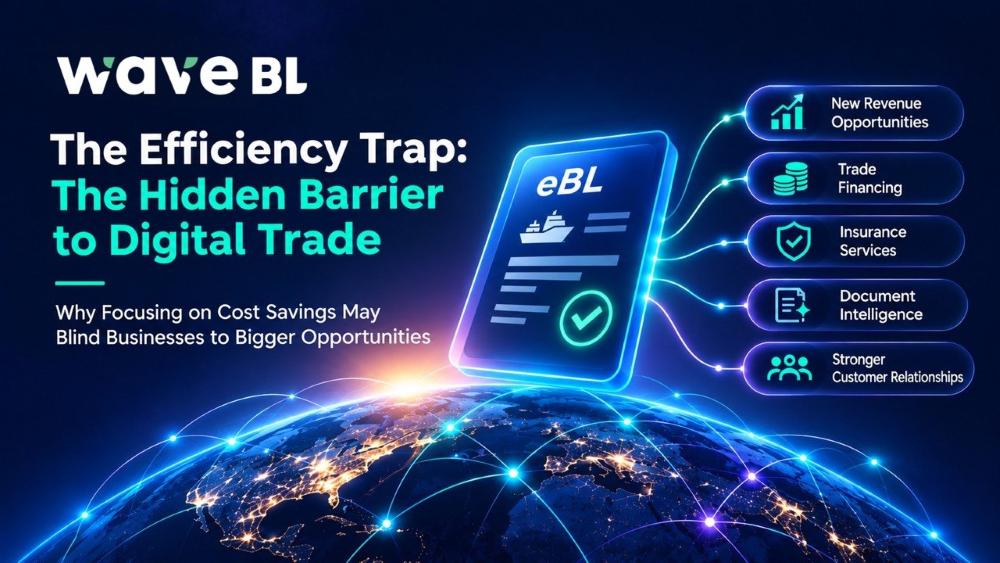
But what if the same digital infrastructure could enable the carrier to offer financing, insurance, document intelligence, and other services to its customers?
Suddenly, the discussion is no longer about reducing administrative expenses.
It is about expanding the business.
The difference is not in the technology being evaluated. It is in the business opportunity being considered.
The Value May Be Outside Your Organization
One of the unique characteristics of global trade is that a single transaction involves multiple independent organizations.
A carrier transports the goods. An exporter sells them. An importer purchases them. A bank may finance the transaction. An insurer covers the risks.
Each participant traditionally evaluates technology based on the benefits it creates within its own organization.
But digital trade documents create value across organizational boundaries.
A carrier’s digital document can help an exporter access financing faster.
An authenticated document can help a bank reduce verification effort.
Trusted shipment information can help an insurer provide more efficient services.
The business value does not necessarily emerge where the document is created.
It may emerge where that document is used.
Organizations that evaluate digital trade only through their internal cost savings may overlook the much larger value created across their business ecosystem.
From Document Processing to Customer Value
Consider two shipping lines offering similar freight rates, transit times, and service reliability.
Both can transport the same cargo.
But imagine that one also enables its customers to access financing, arrange insurance, validate documents automatically, and exchange trusted information with business partners.
Which carrier creates more value for its customers?
And which carrier is likely to build stronger, longer-lasting commercial relationships?
The same question applies to banks, freight forwarders, and other participants in global trade.
Digital documents can become a foundation for services that improve the customer’s overall business experience.
This changes the way digitalization should be evaluated.
Instead of asking only how much a digital document costs, organizations should consider how much additional customer value it can enable.
The Difference Between Cost and Opportunity
Traditional investment decisions often compare the cost of implementing a digital solution against the savings it is expected to generate.
That approach works well when the objective is process optimization.
But it is less effective when the technology creates entirely new business possibilities.
A digital trade document is not simply a cheaper version of a paper document.
When supported by trusted infrastructure and connectivity, it can become an enabler of new commercial interactions.
A bank may discover opportunities to finance transactions that previously required too much manual effort.
A carrier may find new ways to monetize its customer relationships.
A freight forwarder may differentiate its services through faster and more intelligent document workflows.
An exporter may gain faster access to working capital.
These opportunities cannot be fully captured by calculating the cost of issuing or transferring a document.
The price of a digital document and the business value it can unlock are two very different things.
A Different Way to Think About Digital Trade
The most important question for business leaders may no longer be whether electronic documents are more efficient than paper.
That question has largely been answered.
The more interesting questions are strategic:
- What new services could our business offer if trade documents became immediately available, verifiable, and transferable?
- What additional value could we deliver to our existing customers?
- Which business opportunities are currently limited by fragmented documentation and manual processes?
- Could trusted digital connectivity strengthen our competitive position?
- Are we evaluating digital trade as an operational improvement or as a platform for business growth?
The answers may reveal opportunities that are far more significant than the savings generated by eliminating paper.
The WaveBL Perspective
At WaveBL, we believe the real potential of digital trade extends beyond replacing physical documents with electronic ones.
Our approach combines trusted digital document infrastructure, intelligent document processing, and connectivity between participants across the trade document lifecycle.
These capabilities can support more than operational efficiency.
They can provide the foundation for new services, stronger customer relationships, and additional business opportunities.
For shipping lines, this may mean extending their value proposition beyond transportation.
For banks, it may mean reaching customers and transactions through new digital channels.
For insurers, it may mean embedding services into existing trade workflows.
And for exporters, importers, and logistics providers, it may mean gaining access to capabilities that were previously difficult, expensive, or time-consuming to obtain.
The opportunity is not identical for every organization.
But the underlying principle is the same:
A trusted digital trade document should be evaluated not only by the process it replaces, but by the business possibilities it creates.
This approach is already taking shape through services such as AI-powered document validation and enrichment, digital trade document exchange, and trade finance support. By combining these capabilities with trusted connectivity across the trade ecosystem, we aim to help our customers move beyond document processing and create greater value for their own customers.
The Real Question
Digital transformation is often described as the process of doing the same things faster, cheaper, and more efficiently.
But the most valuable transformations do something fundamentally different.
They enable businesses to do things that were previously impractical or impossible.
This is the perspective global trade needs to consider.
The transition from paper to digital documents is important.
But the transition from viewing documents as administrative necessities to recognizing them as strategic business assets could be far more significant.
So perhaps the next time an organization evaluates an eBL solution, the most important question should not be:
How much will this save us?
It should be:
What business opportunities are we leaving on the table by continuing to think of trade documents as paperwork?
WaveBL – Powering the Trade Document Value Chain