By Noam Rosenfeld, CEO of WaveBL (Cyber Security Specialist)
The global trade industry is experiencing a historic, dual technological shift. On one side, the adoption of electronic Bills of Lading (eBLs) is gaining unprecedented momentum, systematically reducing reliance on paper. On the other, the Artificial Intelligence (AI) revolution promises a new level of automation across global supply chains – from automated document matching and smart risk management to increasingly automated cargo release at ports.
On paper, this pairing seems flawless: AI reads digital trade documents and orchestrates global commerce. In reality, however, there is a critical flaw that deserves more attention: supply chain AI can suffer from dangerous partial blindness.
The Scattered Puzzle Paradox: The Vulnerability of Modern AI
For an AI system to truly automate a global trade transaction, it cannot rely on a single document. It must perform what the industry calls “3-Way Matching” in real time. The AI is required to analyze the Bill of Lading (BL), cross-reference it with the Commercial Invoice, validate it against the Packing List, and verify the Certificate of Origin.
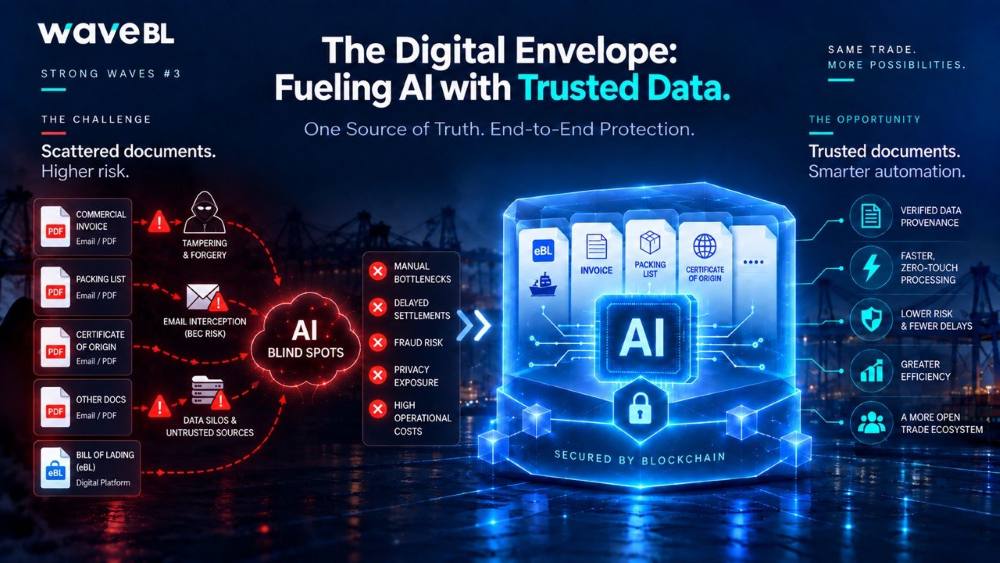
This is where a major structural vulnerability is exposed: while the eBL might be transferred via secure digital infrastructure, the rest of the critical transaction documents are often still sent as standard PDFs over email or uploaded into fragmented, siloed systems.
For an AI algorithm, this creates a classic Garbage In, Garbage Out problem. When AI acts on data from unverified sources, the entire process becomes vulnerable:
- Fraud and Tampering Risks: Standard PDFs sent via email can be altered or forged. AI may analyze a manipulated document and act on it without knowing that the source or content has been compromised.
- Privacy Exposure: Companies may be reluctant to upload sensitive Commercial Invoices and Packing Lists – containing proprietary pricing, vendor names and trade information – into public or third-party AI tools because of concerns about commercial data exposure.
- Manual Bottlenecks: When risk managers, banks and other participants cannot fully trust the source of the data, automated workflows may still need to stop for manual verification. The promise of automation then loses much of its value.
The Breakthrough: AI Demands a “Single Source of Truth”
For Artificial Intelligence to deliver on its promise in international trade, it does not simply need a smarter algorithm. It needs data it can trust. It requires trusted digital infrastructure that can establish the authenticity and integrity of the trade documentation AI is asked to act upon, rather than securing only isolated fragments of the transaction.
This is precisely where the rules of the game are changing. WaveBL is expanding the trust layer beyond the electronic Bill of Lading (eBL), supporting the broader trade-document value chain through the same trusted digital infrastructure.
This approach, which we call the “Digital Envelope”, allows exporters to bundle all transaction documents: the eBL, the Commercial Invoice, the Packing List, and more, inside a secure, decentralized blockchain network. As this digital envelope moves through the ecosystem, every stakeholder (carriers, banks, importers, and customs) knows with 100% certainty that the data is original and entirely untampered with.
The Competitive Advantage of Networked AI
- Uncompromising Data Provenance: The AI knows with absolute certainty that the invoice, packing list, and eBL were issued by authorized entities. This completely eliminates the threat of Business Email Compromise (BEC) and man-in-the-middle data manipulation.
- Zero-Touch Processing: The AI can execute complex 3-way matching in a fraction of a second with total reliability. This enables frictionless, automated cargo release and trade finance bank settlements without human intervention.
- Enterprise-Grade Privacy: Since the WaveBL network is a closed, vetted ecosystem (fully compliant with strict KYC protocols), highly sensitive commercial data remains entirely secure. The AI can process data within this protected environment without ever exposing corporate trade secrets to the public web.
The Bottom Line: The Future Belongs to the Network, Not Just the Algorithm
Organizations that continue to scatter their trade documents across disconnected systems and standard email risk leaving their AI with an incomplete and potentially unreliable view of the transaction. The key to efficient and secure global trade automation does not lie in the AI tool alone, but also in the infrastructure and data foundation upon which it operates.
WaveBL’s expansion beyond the eBL to support the broader trade-document value chain is more than a technical evolution. It creates the trusted data foundation AI needs to move from analyzing trade documents to becoming a meaningful part of how global trade operates.
Because smarter automation starts with data you can trust.