Separating Trust from Capital: The Next Evolution of Trade Finance
By Noam Rosenfeld, CEO of WaveBL
For centuries, banks have played a central role in global trade. They did not only
provide capital. They provided something equally important: trust and control.
Banks verified documents, controlled Bills of Lading, managed the release of goods,
and acted as trusted intermediaries between parties that often did not know or trust
each other.
But what happens when technology can provide much of that trust and control digitally?
The combination of trusted digital trade infrastructure and alternative capital could
fundamentally change the structure of trade finance.
The objective is not to eliminate banks.
It is to make the bank optional.
Why Banks Became Central to Trade Finance
Traditional trade finance was designed around paper.
Original Bills of Lading had to be physically transferred. Documents had to be checked manually. Ownership and possession had to be established. Different parties needed confidence that the same original document could not simultaneously be used elsewhere.
Banks became a natural control point.
This worked, but it also created a complex and expensive infrastructure around the
movement and verification of paper.
Today, electronic Bills of Lading can change that architecture.
If an eBL can provide reliable digital possession, uniqueness, authenticity, secure
transfer and a complete audit trail, then one of the fundamental reasons for requiring a traditional intermediary begins to change.
Control of paper can become control of a trusted digital asset.
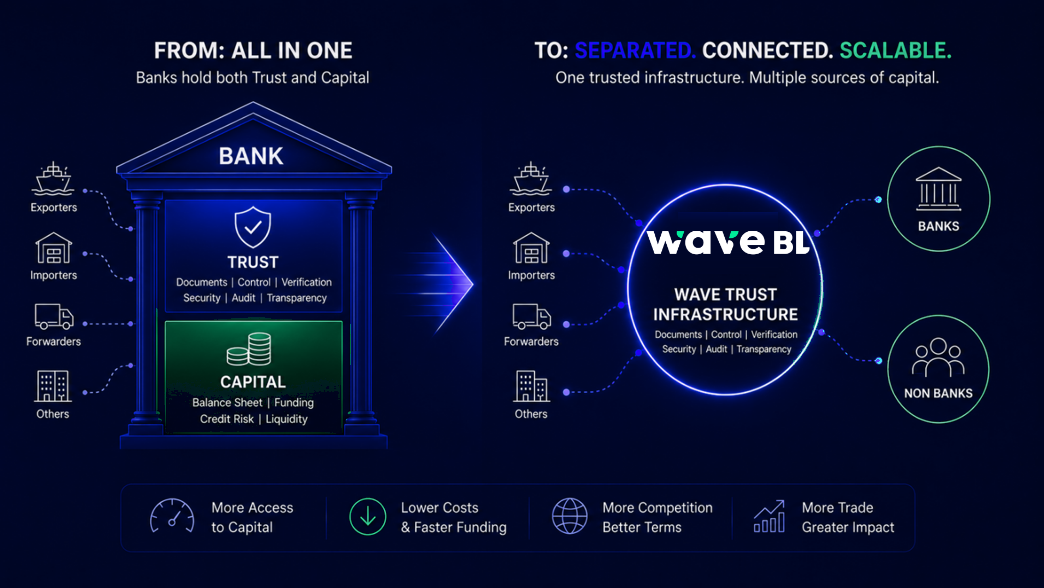
Separate the Infrastructure from the Capital
This creates an interesting opportunity.
A trade finance transaction fundamentally requires two things: Trust infrastructure + Capital
Traditionally, banks have provided both.
But they do not necessarily have to come from the same institution.
WaveBL can provide the trusted digital infrastructure: the electronic original, secure
possession and transfer, transaction history, document data and connectivity between trade participants.
Alternative lenders can provide the capital, underwriting and credit-risk management.
Together, these capabilities could create an entirely new financing model.
From Lending to Digital Asset-Backed Trade Finance
Imagine an exporter shipping $1 million of goods.
The carrier issues an eBL through WaveBL. The transaction and relevant documents
are digitally available and verifiable.
An alternative finance provider evaluates the transaction and agrees to finance
$800,000.
As part of the financing structure, the lender receives the appropriate control over the
eBL.
The exporter receives funding.
When the financing conditions are satisfied, control of the eBL can be transferred to the appropriate party and the financing repaid according to the agreed structure.
Instead of relying primarily on the borrower’s balance sheet, the financing can increasingly be structured around a specific trade transaction, its documents and the underlying goods or receivable.
This could open trade finance to new providers of capital and potentially to companies that struggle to obtain sufficient financing through traditional banking channels.
AI Can Take This One Step Further
Digitizing the Bill of Lading is only the beginning.
Trade finance involves multiple documents: invoices, Bills of Lading, certificates,
purchase orders and other commercial documents.
Historically, people have spent enormous amounts of time reviewing these documents, comparing information and identifying discrepancies.
AI can increasingly perform parts of this work.
It can extract information, compare documents, detect inconsistencies, identify missing information and help assess whether a transaction meets predefined financing criteria.
Combine that with trusted digital originals and the financing process starts to look very different:
Trade happens → Documents are created → AI understands and validates them →
Financing eligibility is determined → Capital is offered → Funding happens.
What today may take days could increasingly happen in hours -and eventually, for
appropriate transactions, potentially much faster.
WaveBL Will Not Become a Bank
The strategic direction of us, is not necessarily to become a lender.
Taking credit risk would fundamentally change the company’s business model, capital requirements and regulatory profile.
Our bigger goal is to become the infrastructure connecting trade with capital.
WaveBL already sits at an important point in the transaction: where trusted trade
documents are created, transferred and managed.
If financing capabilities are connected to that infrastructure, an eBL transaction could eventually trigger a question automatically:
“Would you like to finance this trade?”
Eligible transactions could then potentially be matched with participating financing
providers.
Different lenders could specialize in different geographies, commodities, transaction
sizes, risk profiles or financing structures.
WaveBL would provide the rails.
The financing ecosystem would provide the capital.
From eBL Platform to Financing Rail
This represents a much bigger goal than simply digitizing an existing banking process.
Consider the evolution:
Paper BL → eBL → Trusted digital trade transaction → Financing-ready transaction → Embedded trade finance
At the final stage, financing is no longer necessarily a separate process initiated after
the trade transaction.
It becomes a service embedded directly into the digital trade flow.
That could significantly reduce friction for exporters and importers while creating a new distribution channel for non-bank lenders.
The Network Makes the Model More Powerful
There is another reason this model becomes particularly interesting when built on a trade network.
Financing does not exist in isolation.
It involves carriers, exporters, importers, freight forwarders, financial institutions and other participants.
The more of these parties that are already connected to the same trusted infrastructure, the easier it becomes to create financing-ready transactions.
And this can create another network effect:
More trade participants → More digital transactions → More financing opportunities → More lenders → Better availability of capital → More value for participants → More transactions.
At sufficient scale, the network could begin connecting not only the parties moving
goods, but also the capital required to move them.
Banks Will Still Matter
None of this means banks disappear.
Banks have enormous advantages: access to low-cost capital, regulatory infrastructure, global relationships, deep expertise and very large balance sheets.
They will remain critical participants in global trade finance.
In fact, banks themselves can participate in the same digital infrastructure.
But they may increasingly become one source of capital among several, rather than the mandatory infrastructure through which every financed trade transaction must pass.
That distinction matters.
The Vision
To separate trust from capital.
To enable the next generation of lenders to finance trade through the control of digital
assets based on Trusted digital infrastructure.
Bank will no longer be the only option for Trade finance.